THERE’S NO BONES ABOUT IT
Our bones are the support structure, the scaffolds, of our body. While you may have your own reasons for maintaining strong foundations, maintaining mobility and preventing falls is fundamental to moving comfortably and confidently as we age.
So, how do you promote healthy bones? Let’s understand their make-up first.
Your Bones
Your bones are made up of collagen protein, calcium phosphate and bone cells. The bone cells form the complex process of bone remodeling and are made up of:
Osteoblasts: The cells that builds new bone tissue (mineralisation).
Osteocytes: The cells that maintain bone by detecting shock, impact, stress and signalling mineral balance.
Osteoclasts: The cells that break down old or damaged bone tissue and reabsorb into your body.
Inside the hard bone tissue is a scaffolding network of collagen proteins, Cancellous tissue, which looks similar to the texture of a dish sponge. If bone cells are not built, maintained or replaced as they are naturally broken down, we face the risk of degenerative bone diseases.
Your Joints
For added context, your joints play a pivotal part in promoting healthy bones. A joint is where two bones meet, held together with connective tissue (cartilage, tendons, ligaments and nerves). Of the three different types of joints, synovial joints are freely movable, categorised into subtypes based on the movement they allow.
Between two synovial joints, you have:
Cartilage
Joint capsule
Synovial fluid
Supporting tendons & ligaments
BONE HEALTH AS WE AGE
HOW Menopause AFFECTS BONE DENSITY
The hormonal shift during Menopause, specifically the drop in oestrogen, causes bone density loss. Within 5 years of menopause, 10% of bone density is lost on average. The loss of bone density combined with the lack of stimuli to promote the regeneration of new cells can lead to degenerative bone diseases and conditions.
‘Oestrogen plays an important role in maintaining bone strength. Bone density rapidly rises after puberty under the influence of oestrogen and peak bone mass is reached around age 30.’
– Australian Menopause Society
Osteopenia & Osteoporosis
Osteopenia is the clinical diagnosis for an individual with lower than normal bone density. Like an amber light, it’s a warning sign to consider management options before reaching the markers of Osteoporosis. Osteoporosis is the diagnosis of structurally weak bones that are at high risk of fracturing or breaking.
In an osteoporotic person, the bone healing process remains the same, however healing time is prolonged with an increase in weakness surrounding the break even after healing. Testosterone plays a vital part in bone generation (Shigehara, K. et al, 2021), however testosterone dominant individuals are also at risk of developing Osteopenia and Osteoporosis. The risk factors that contribute to the development relate to personal history, like genetics and lifestyle, certain medical conditions, and medications. (Healthy Bones Australia).
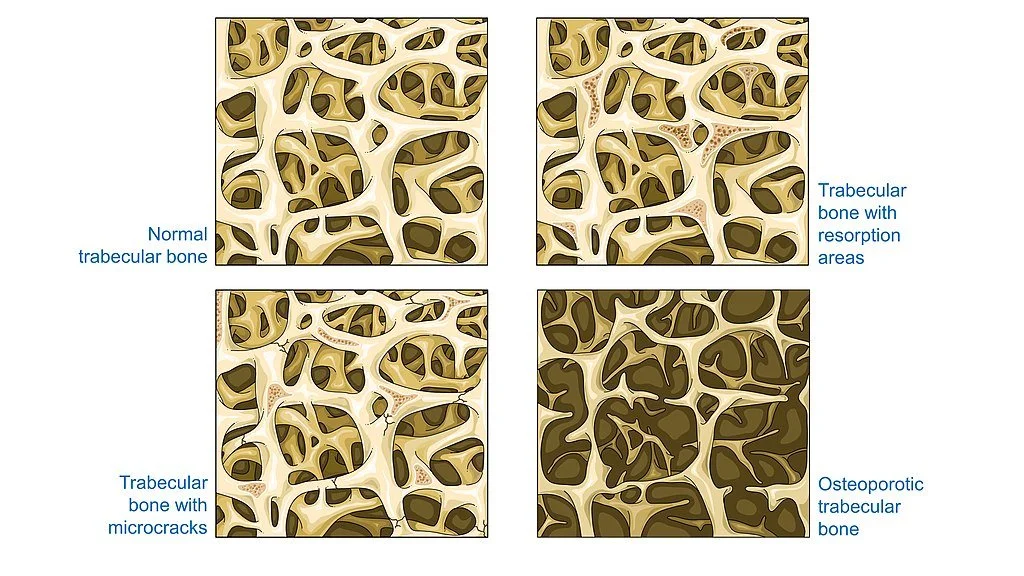
A visual of the scaffolding network within the bone in normal and osteoporotic bone.
Image Source: Physio-Pedia
Osteoarthritis & Joint Degeneration
When the cartilage that cushions the bones at a joint has worn down, bone will rub on bone. This friction can lead to symptoms that gradually get worse over time. Joint hydration is essential to healthy joints. As cartilage has no blood supply, it relies upon the actions of movement to expel waste products and absorb nutrients. We can encourage the maintenance of our joints by integrating movement and ensuring adequate hydration.
When joints are hydrated, we see more:
Nutrient uptake
Synovial fluid circulation
Muscle support
Promoting Healthy Bones
The musculoskeletal system is highly complex, so I’d like to start with the caveat that there are many risk factors that contribute to bone health. We’ll be looking explicitly at lifestyle choices we can make through exercise and specific movement skills that have been proven to promote healthy bones and joints, and ultimately longevity.
Movement Skills for Bone Health
The moment we’ve been waiting for - how can we make impactful and considered choices when it comes to our longevity. It can be helpful to split exercises and movement skills into two categories:
Stimuli for the maintenance of bone density
Stimuli for falls prevention
Stimuli for Bone Density
A 2018 study concluded that ‘combined exercise and group exercise programs, including weight-bearing activities, balance training, jogging, low-impact loading, high magnitude exercise, muscle strength, and simulated functional tasks, are advised to determine BMD increasing or at least to preserve it.’ Benedetti, M. G. et al. (2018).
Impact Loading
Applying mechanical stress to the bone, (through running, jumping or hopping movements), stimulates the bone cells to rebuild and strengthen tissue.
Progressive Resistance Training
‘Bone requires regular dynamic (cyclical) loading to stimulate a positive adaptive response or to prevent age related loss.’
– Health Bones Australia
Non-weightbearing and low-impact exercise shows little to no response to improving bone mass. Consider that although Pilates is primarily described as non-weightbearing and low-impact, there are many opportunities where both types are regularly integrated into class programming at Revere Pilates.
Using spring resistance (on a Reformer or other spring-based Pilates apparatus) alongside strength training principles stimulate a positive adaptation. We must consider that spring resistance (or any dynamic load) must exceed habitual loading exposure to induce an adaptive response.
To put it simply, for your bones to positively adapt to loading and improve (or at least maintain) your bone density, they must be loaded with more than what normal, habitual movement offers; that is more than what is standard to your everyday habits and demands.
Stimuli for Falls Prevention
Balance Training
Balance training is an important movement skill for falls prevention, but holistically, it can also:
Improve posture
Improve strength
Improve standing balance and locomotor performance in older adults
Improve self-confidence with balance control leading to reduced fear of falling, increased walking speed, and improved physical function
Improve quality of life
To challenge and improve balance skills, integrating static holds and dynamic stability exercises into your regular routine are recommended.
Movement Skills for Joint Health
Exercise for Promoting Joint Hydration & Health
Low-impact movement where you minimise the force and stress between joints.
Resistance and Strength Training to build strength to the muscles surrounding and supporting high-use joints.
Aerobic Exercise to improve joint lubrication, reduce inflammation and reduce stiffness.
Mobility-based Exercise to nourish cartilage, improve joint range of movement, prevent injuries and neuromuscular control.
Balance Training as previously discussed.
Osteoarthritis prevention & management
Whilst there are many different pathologies and degenerative conditions of the joint, Osteoarthritis (the deterioration of articulate cartilage) is relevant to the overall picture of bone health.
Cartilage within the joint can deteriorate for a number of reasons:
General wear and tear as we age.
Traumatic injury.
Overuse.
Lifestyle factors.
Medical history & genetics.
Once the cartilage is worn down, we lose the shock-absorption properties of impact and experience an increase in friction between the bones. Degenerative conditions like Osteoarthritis can be managed through similar exercises and movement skills seen to promote bone density. There are a number of exercises that have a proven therapeutic benefit to managing Osteoarthritis including, aerobic exercise, strength training, swimming, neuromuscular exercise, proprioceptive training, and balance training. Kong, H., et al (2022)
Whilst bones and joints form two distinct parts of your musculoskeletal system, exercise is mutually beneficial in promoting health and preventing degenerative conditions. We can’t consider one without the other, and to move freely with longevity in mind is a core value you can honour in your practice. Fundamentally, we exercise to maintain a good quality of life, age comfortably and remain independent, strong and confident for as long as possible. We practice and move for our future selves.
ReFERENCES & DOWNLOADABLE RESOURCES
Guidelines - Healthy Bones Australia
Healthy Bones Exercise Fact Sheet - Healthy Bones Australia
Men’s Bone Health Explained - Healthy Bones Australia
Osteoporosis Information Sheet - Australian Menopause Society
Pain Management: Exercise - Arthritis Australia
B.R. Beck et al. (2017). Exercise Prescription to Support the Management of Osteoporosis For Physiotherapists and Exercise Physiologists. Journal of Science and Medicine in Sport 20 438–445, https://healthybonesaustralia.org.au/wp-content/uploads/2024/02/hba-ex-presc-final-compressed.pdf
Healthy Bones Australia, March (2024). Osteoporosis management and fracture prevention in postmenopausal women and men over 50 years of age. Extract of Summary of Recommendations
Shigehara, K., Izumi, K., Kadono, Y., & Mizokami, A. (2021). Testosterone and Bone Health in Men: A Narrative Review. Journal of Clinical Medicine, 10(3), 530, https://doi.org/10.3390/jcm10030530
Benedetti, M. G., Furlini, G., Zati, A., & Letizia Mauro, G. (2018). The Effectiveness of Physical Exercise on Bone Density in Osteoporotic Patients. BioMed research international, 2018, https://doi.org/10.1155/2018/4840531
Balance Training. (2025, April 20). Physiopedia, https://www.physio-pedia.com/w/index.php?title=Balance_Training&oldid=367986
Kong, H., Wang, X. Q., & Zhang, X. A. (2022). Exercise for Osteoarthritis: A Literature Review of Pathology and Mechanism. Frontiers in aging neuroscience, 14, 854026. https://doi.org/10.3389/fnagi.2022.854026
While we have made every effort to ensure the information in this post is accurate and informative, the information does not take the place of professional or medical advice.
Do not use our information to diagnose, treat, cure or prevent any disease or as a substitute for the advice of a health professional.
No AI tools were used in the creation of this blog article.